„Thank you, Chef.“
3 Likes
Seems like Hawley gets it…
1 Like
Oh yes…
1 Like
This is now the third adaptation of The Talented Mr Ripley - and both Delon and Damon were already very good and tough acts to follow. I’d rather they went with the second Ripley novel and keep the ‘origin’ parts for flashbacks.
Also, Scott is perhaps just that little bit too spoilt for the part since Moriarty. Don’t get me wrong, I have little doubt he’ll be fine - but he should have played that character 15 or even 20 years ago.
4 Likes
Funny, but as I looked at the trailer, I thought: “He is too old for the Ripley of the first novel.” In the first story, we discover how Ripley became Ripley. In “Ripley’s Game” and “Ripley Underground,” we get a ripened Ripley–criminal, and also leading the good life. Then comes my favorite “The Boy Who Followed Ripley,” followed by Tom’s swansong, “Ripley Under Water,” where his major crime is dumping a human skeleton into a neighbor’s pond (which does lead the the death of two characters, who drown while trying to retrieve it).
1 Like
Exactly. It all will be well made and intelligent - but surprising it won’t be.
1 Like
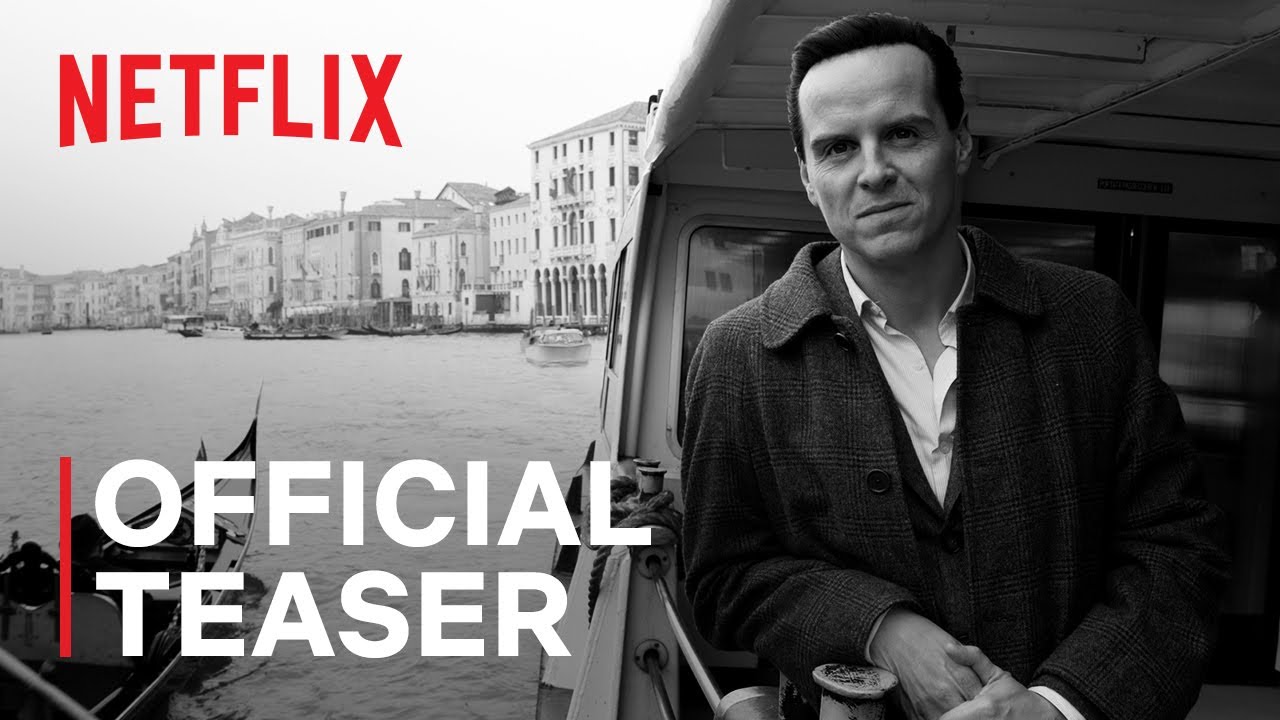
I particularly wonder why they went with b/w scheme here. If anything the story calls for the colourful vibrant images we’ve seen in both prior adaptations. I’m not sure this is helping beyond giving the production a little leeway with dresses, costumes and props.
Also, looking at Netflix’ You, isn’t there already a more contemporary, more interesting version of Ripley? I’m willing to give this a try, but a far more intriguing decision would have been to pick up Ripley’s tale midway or even towards the end and only reveal his nature gradually over one or two seasons in flashbacks.
Though I do so rarely, I am going to disagree with Dustin. Minghella pushed the action of the novel by about three years, so as to be able to film Italy in a more colorful time.
Highsmith set the novel when Italy was still in recovery, so actually a plainer/neo-realist look would be the most accurate representation of the story’s landscape.
The trailer seems to show a high-contrast black-and-white approach, which while eschewing the lavishness of color, substitutes the luxuriousness of high-contrast. The mundane, everyday nature of Ripley’s path to evil would be best served by a Rossellini/DeSica visual approach.
And just because it is one of my favorite movies, and a Rossellini peak:
1 Like
Steven Zaillian: “The edition of the ‘Ripley’ book I had on my desk had an evocative black-and-white photograph on the cover. As I was writing, I held that image in my mind. Black and white fits this story—and it’s gorgeous.”
1 Like
Highsmith said she was “not interested in style.” Her prose is direct, blunt even, and allows complete access to all details in an effort to facilitate clarity, understanding, and identification. Her prose is gorgeous only in the way a zen garden is resplendent.
2 Likes
Star Trek: Voyager
What?
Yes. The 90‘s Show. I remembered it as a lesser show, definitely not my favorite Trek, and I guess I was trekked out at that point anyway.
Cut to now. My wife and I are binge watching Voyager and enjoying it absolutely. The crew is perfect, the adventures are exciting and interesting, and it also poses intellectually challenging questions, just like the best Trek.
We’re currently at the end of the fifth season, so two more to go. What a rediscovery. (Full disclosure: in the 90‘s we probably did not see every episode, since it only became available in Germany first as DVDs packing about four episodes on one, then you had to wait for months to get the next DVD, then a tv station picked it up - but we definitely lost track. So many episodes are now completely fresh for us. The magic of streaming.)
3 Likes
What a coincidence, I’m just into S7 on my re-watch! I’ve always had a soft spot for Voyager as it was airing when I was growing up, so it was actually the show that got me into Star Trek.
I do feel like it often is unfairly dismissed. At its best it’s a good as any other Star Trek, and at its worst it’s no worse. The shows premise is fantastic - a lost ship with a rival crew needing to work together to get home. Granted, they perhaps should have delved into the struggles of the crew gelling a bit more (in fact the premise is probably perfect for a modern streaming series).
A lot has been made of the resetting of the status quo between episodes, pointing especially to Kim’s lack of promotion, however I think of the classic Trek shows (aside from perhaps the more serialised DS9), the crew has the most character development, with at least four of the nine main cast (Seven, the Doctor, Paris and Torres) fundamentally changed.
2 Likes
Absolutely agreed.
And I personally think the Doctor and Seven are two of the most interesting characters in the whole Trek universe. Just yesterday I watched the season 5 episode in which the Doctor tries to teach Seven how to date. This is high comedy with such a poignant, sad ending, pared with the great sideplot of the alien ambassador really trying out everything on board which he usually is not allowed to do. What a great episode.
3 Likes
The Bear - Season 2
Still amazingly fantastic.
2 Likes
So what seemed to change for you with Voyager?
More concentrated, yet relaxed viewing, watching the whole series without months or even years between seasons or episodes.
Also, in the 90´s I was in my late 20´s and had some rather, um, pretentious ideas of what movies had to be like, and tv was second tier, if that.
Basically, I was not in the mood for it. Now I am, sitting back and really appreciating what it is and sets out to do.
I´m now in the seventh season, and it is interesting to see how from season to season the show did evolve, focusing on characters more than adventure thrills.
And it really has so many great characters, working together to create the kind of chemistry “Discovery” never achieved (due to concentrating on Michael much too much, turning her into an action heroine who solves everything, while the rest of the crew on the bridge is rather indistinct.)
I love how humorous Voyager can be, by the way - something Trek always needs and had lost during “Discovery”.
I don´t want to leave the impression that I hate “Discovery”. I do think it had some very good episodes. But I never enjoyed it as much as “Strange New Worlds” which I loved very soon after it started.
Am I just old and responding to the things which are modeled on stuff I encountered during my formative years? Probably. Still, not taking itself too seriously, for me, is always the better way for fictional entertainment.
3 Likes
Strange New Worlds is IMO the best modern adaptation of the Trek idea - and to me it is modern in its character driven concept that still leaves room for adventure-of-the-week fare. If only they had restarted Trek with this and hadn’t bothered with Discovery, or Picard even.
Voyager I watched on its original run and quite loved it back then. The main accusation against it, that the show doesn’t take its own premise seriously and instead time and again resets its protagonists, didn’t disturb me a lot. For me it was mainly about how good the crew dealt with being on its own, in a hostile environment with various factions, most at least as advanced as Federation technology. How they kept up morale, discipline and how they were able to integrate strangers into the crew.
Many great ideas kept coming up during these seasons, the Doctor, the Maquis conflict, Seven-of-Nine giving the Borg not just a face but a background and a culture of sorts. And so on, plenty of these elements keep coming up regularly in Trek lore to this day and add to shows, fiction and fan creations.
Yes, Voyager jumped the shark a couple of times - but you still could watch it and be entertained to the last episode. That said, I haven’t rewatched it since those days in October 2001. Must go and revisit it one of these days.
4 Likes
Just finished 2017’s ‘Counterpart’ - how was this not more of a thing? Think ‘spies in Berlin’ - only it’s not East and West but our world and some slightly but significantly different mirror version that has seen its population decimated by a pandemic. Eery coincidence, no?
This show opens slowly with Kafkaesque scenes, like outtakes of The Prisoner meets The Process, before its plot unfolds to reveal an sf-spy pattern that carries a deeper undertone of ‘what-if’ and ‘what-might-have-been’.
J K Simmons is patently, demonstrably fabulous in depicting ‘our’ accountant Howard, a best-ager who only made it to junior rank civil servant in some bizarre - faceless, pointless, joyless - UN-subdivision ministry nobody really knows what it’s all about. Here he performs mysterious surreal tasks, cryptic exchanges with other civil servants.
Until one day he sits across from a hooded figure who turns out to be ‘their’ Howard - a hard boiled operative from the other world who only wants to work with our authorities if it includes ‘our’ Howard.
Going much deeper into it would spoil the show. Suffice it to say this turns up with surprises and ever more strange twists while giving its characters depth and structure and moral quandaries aplenty.
Season one was great; I’m just dipping into the second (and last) season.
3 Likes
I was aware of it when it was released but for some reason never watched it despite enjoying Simmons as an actor.
I should search for it now.
1 Like
Did anyone else watch True Detective: Night Country? I’m a fan of the series, and was so hoping to like this installment. It had all the right ingredients … but I felt like I was being taught a lesson, rather than witnessing the lives of people committing, solving and being impacted by crimes. The mythology and supernatural elements were presented in too heavy-handed a way, trying too hard to explain everything. I never felt a sense of mystery or impending doom. Contrast that with … well, any of the previous three seasons.
The fist episode felt like an information dump. And then the pacing in subsequent episodes was odd. Every time I felt like I was finally being drawn into the story, it would stall out in yet another expository sequence. I had hope after the fourth and fifth episodes improved somewhat, but then the finale felt like another info dump, with several implausible details that stuck out to me (and I’m someone who normally doesn’t get too wound up about these things):
- How could Danvers and Navarro not know that their ice cave map was leading them directly under Tsalal Station? It’s not like they were wandering down there that long.
- Both of them falling through, without being injured, is a stretch. And, why didn’t they didn’t bother to bring along any rope or other supplies one might need when exploring a cave, frozen or otherwise?
- Unless it’s my imagination, what we see in Annie K’s video is quite different from what we see when she is murdered. Where is the underground lab equipment in her video? All we see is an ice cave, remarkably similar to the one Danvers and Navarro were doing their amateur spelunking in.
I have read that Night Country was originally pitched as its own series, but HBO decided to put it under the True Detective umbrella. And I think that may be what led to my problems with it. The desire to tie it in with the first season, and insert a bunch of callbacks that seemed to have no relevance to the plot, made it far too convoluted, with too much reliance on telling us rather than showing us. Disappointing.
2 Likes