What Movie Have You Seen Today?

I watched it too last night. Great wasn’t it?

Much better than I remembered. Roger is excellent!

I also liked Claudie Lange a lot. She looks like a kind of cross between a young Sophia Loren and Virna Lisi, if that makes any sense?

Martha Hyer is more the “Kim Novac” type, distant and Icy and in this case even dangerous.

Francis Matthews is one of the other villians and delivers like he always does, together with Bernard Lee, who’s part is unfortunately very short.

The title is litterally into the movie and contains an important clue.

3 Likes

Ah, Francis Matthews, my old childhood hero. I loved him as Paul Temple, and of course as host of the English language TV course “Follow Me!” which ran on German TV in the early 1980s. This put me in the position that I already knew the basics before I started learning the language in school a few years. Not sure if I’d be discussing on here without him (okay, translated song books of the Beatles, the Stones, Bob Dylan and Frank Zappa helped a bit, too :smirking_face: )

5 Likes

Due to recent events I’ve been subscribed to a number of newsletters and podcasts concerning themselves with various aspects of current affairs and economics in the widest sense. One of them, War By Other Means, looks at a number of classic war/political thrillers through the lens of national security. Because it’s interesting to (re-)watch some of these with certain questions and premises in the back of the mind I just put that entire list here for further inspiration.

Blood on the Big Screen

National Security Films for the Whole Family

JAMES
MAY 12 40x40
18x18 18x18 18x18 18x18 READ IN APP18x18

550x230.3125

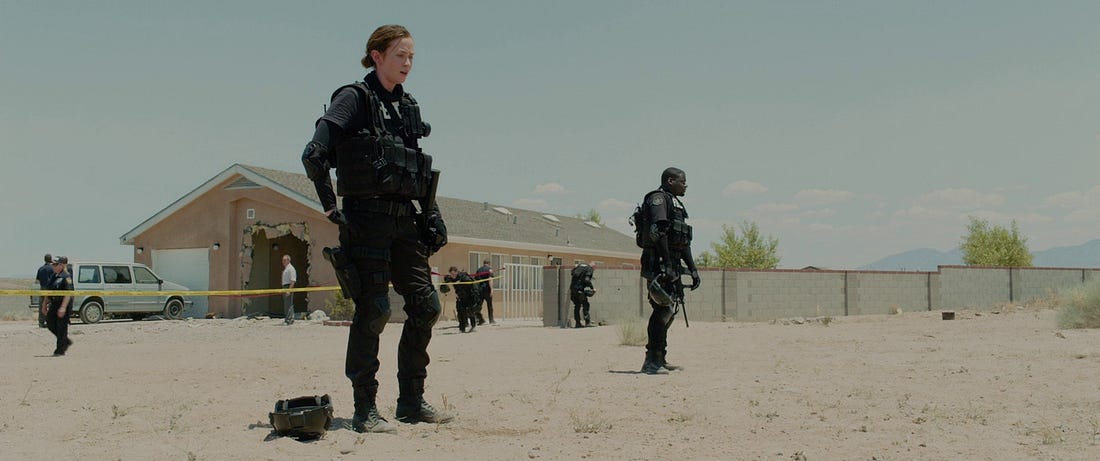
Sicario, Villeneuve, 2015

It’s been a while since I’ve written about film, literature, or music. Which is what I actually want to write about. I am just forced to write about other things against my will. So I’m writing about films I think people interested in national security should watch.¹

Thanks for reading War By Other Means! Subscribe for free to receive new posts and support my work.

Pledge your support

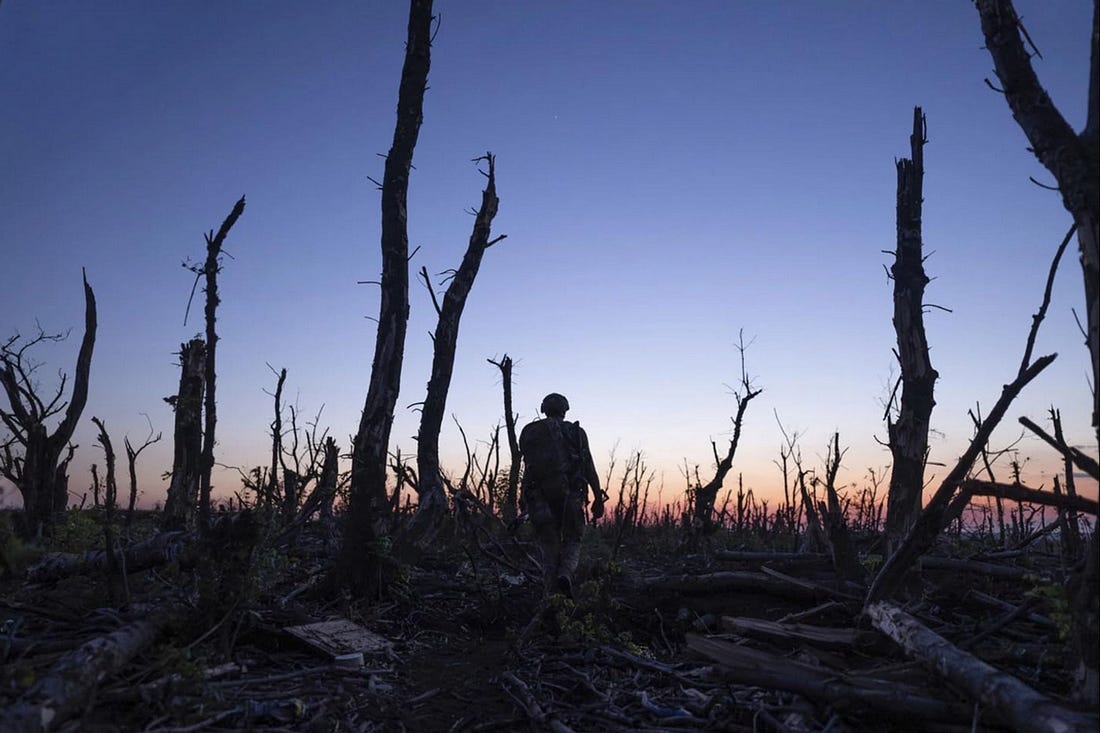
2000 Meters to Andriivka
550x366.41483516483515

2000 Meters to Andriivka is a documentary set during the 2023 Ukrainian counter-offensive and focuses on a singular Ukrainian unit fighting through a small strip of forest. It’s a small and claustrophobic film told largely through GoPro footage from the fighters involved in the offensive.

People oftentimes forget—when looking at the scope of these conflicts—that the actual battles that take place are hyperlocal. It’s small groups of men and women engaged in bloody fighting in thousands of strips of land across a nation. It’s not some large coherent thing that can be intuited by looking at arrows on a map, but struggles between dozens of people playing out across the scope of an entire front.

If you care about these things, you have to remember that nothing happens in the abstract. It’s not just looking out across a strategic and operational concept and weighing numbers on a ledger. It’s one squad of friends in a brutal slog to take one position at a time.

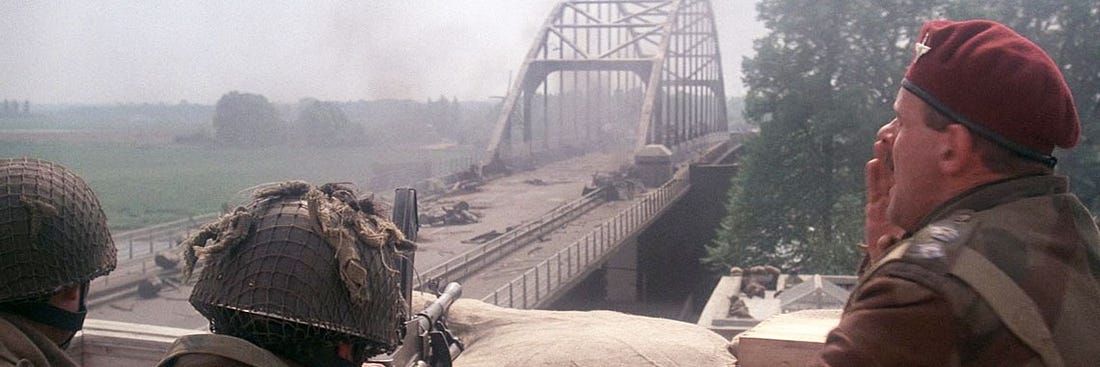
A Bridge Too Far
550x183.33333333333334

This is, in some ways, an addendum to 2000 Meters to Andriivka.

Operation Market Garden was—despite the best efforts at revisionism from some—a disastrous Allied operation in World War II based on flawed assumptions and unrealistic expectations. Told as a historical drama, A Bridge Too Far captures the planning and fighting of Operation Market Garden from the strategic level down to the tactical levels of individuals fighting over the various objectives.

How it is that strategic and operational planning is conceived through idiosyncratic political necessities and the personalities of individuals at higher levels ends up impacting the fates of individuals tasked with carrying out those plans is essential to understanding the responsibilities placed on any decisions regarding war and peace.

It is a case study in how hope and optimism that is untempered by reason over what is and is not possible will, inevitably, be crushed by reality.

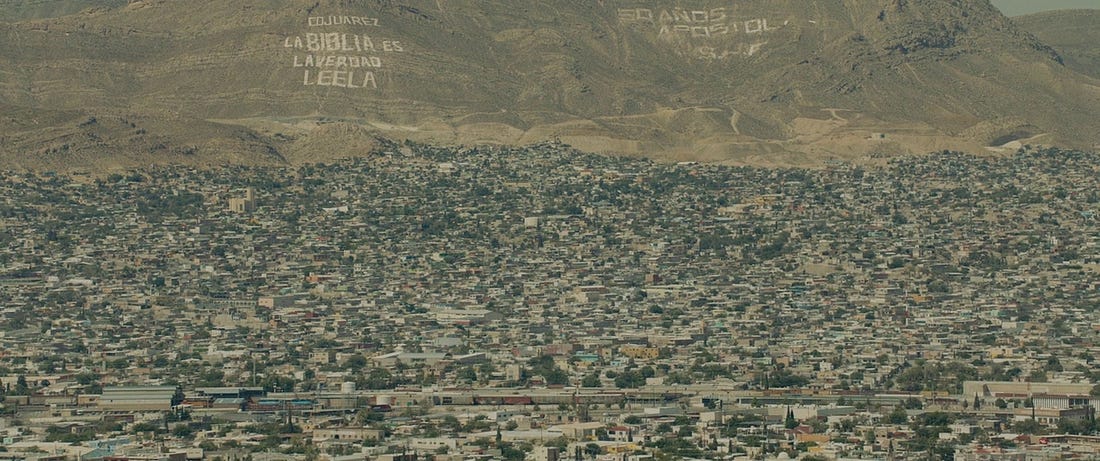
Sicario
550x230.3125

What is even possible to accomplish in national security? Can we actually achieve a grand strategic end state as we did in the aftermath of the Second World War? Or is the best we can hope for just managing a crisis and keeping risk within acceptable bounds?

Sicario is a film about a lot of things. The aesthetic appeal of violence. The amoral nature of national interests. How cool mustaches look. How amazing a cinematographer Roger Deakins is.

It’s also worth seeing as a film about the limitations on options and how we deal with concerns that fall further down on our priorities.

We don’t have the political will to actually combat a problem. We can never seem to implement policies that will address the roots of an issue. What do we do then? Maybe we just have to live with a world where the best we can do is short-term mitigation and kick the can down the line for someone else to deal with.

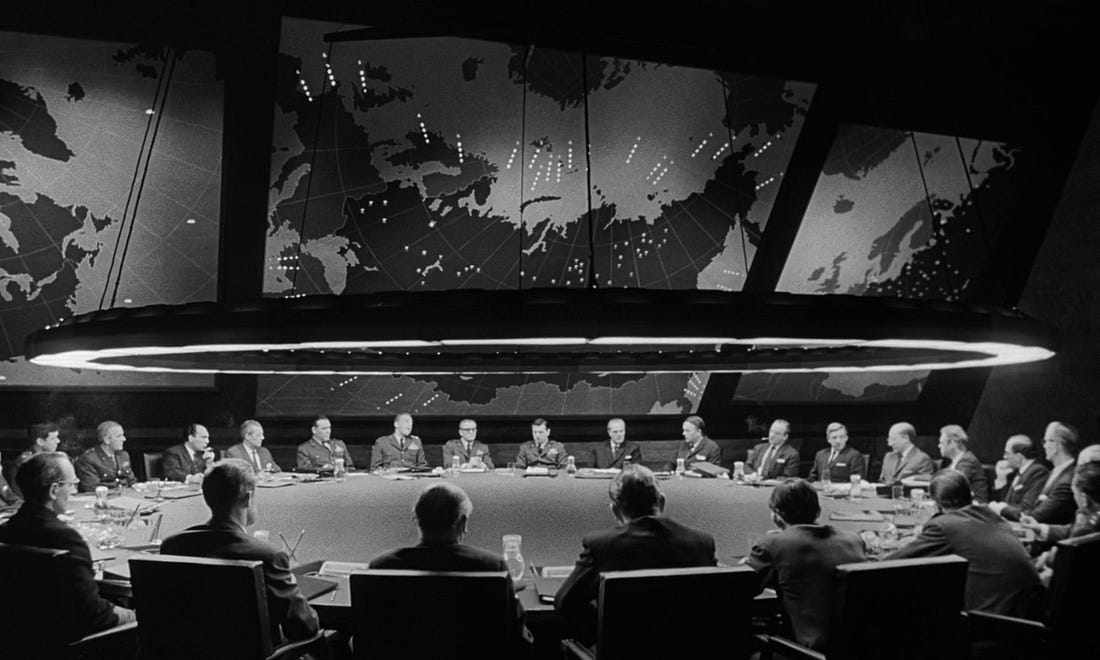
Dr. Strangelove
550x330

Speaking of managing risks, why do we consider risks when we talk about national security? We think of the great opportunities that the use of national power can achieve, but what happens if it all goes wrong?

Dr. Strangelove is obviously a satirical film, but it was based on arguments around deterrence that were prominent during the Cold War. Besides the commentary on how insane the capability to inflict widespread death on adversaries is—the film has a worthwhile point about what we’re doing when we’re doing national security.

What is your job when thinking of national security? Is it just thinking about marshalling instruments of national power to achieve interests? Or is it about calculating ranges of options that fall within an acceptable boundary of risks? Are you really being serious about national security if you’re not considering that just maybe an adversary will escalate past what you thought was possible?

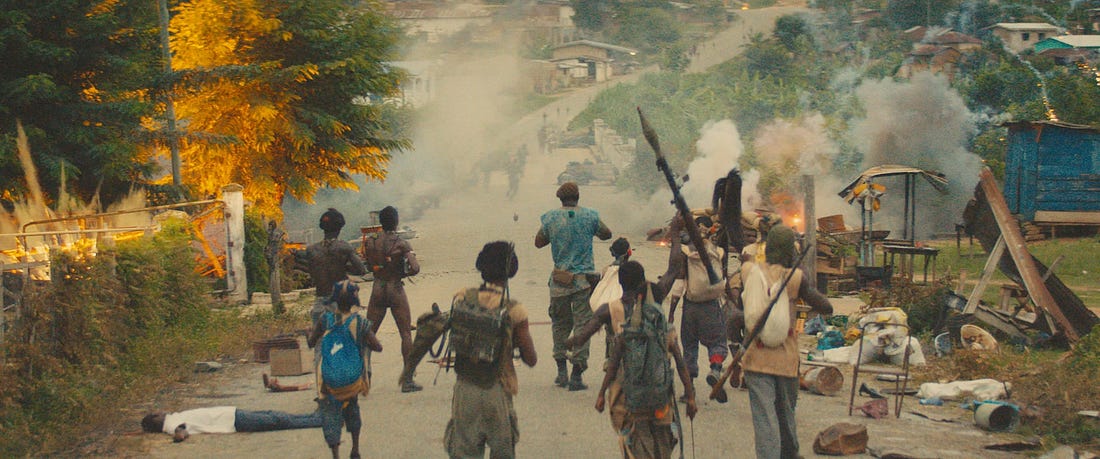
Beasts of No Nation
550x229.67032967032966

The problem with thinking of nothing but risks—and only with potential consequences—is that you forget what instruments of power can actually accomplish. Across the world, conflicts rage that barely reach the pages of newspapers.

Beasts of No Nation is about one of those conflicts. Quiet on an international scale. Without any real end in sight. Destroying the lives of everyone involved. The arcs of the lives of individuals are irretrievably broken because of the violence they become participants in.

We hear about Gaza. We barely hear about Sudan. Or Myanmar. Or the Central African Republic. We forget that in dozens of countries across the globe, millions of lives are torn apart by the constant fighting and destruction caused by chronic insecurity.

We mostly stood aside while al-Assad gassed his own people. We did nothing when the Tutsi faced genocide in Rwanda. We made half-hearted statements of concern about killings in the Congo.

It’s easy to find yourself wrapped up in a supposed “realist” calculus about the distribution of power in the world and become absorbed in your own theories about what the best allocation of resources is. You can always talk yourself into how something shouldn’t be done. It’s easy to forget that those decisions cause people to live lives filled with death and destruction that could have been different.

The Battle of Algiers
550x343.75

National security is also a question about who exactly you are. It’s often put forward that there are objective things that can be called national interests . But it’s not exactly true.

National security is a statement about principles for a political community, and it reflects who we are.

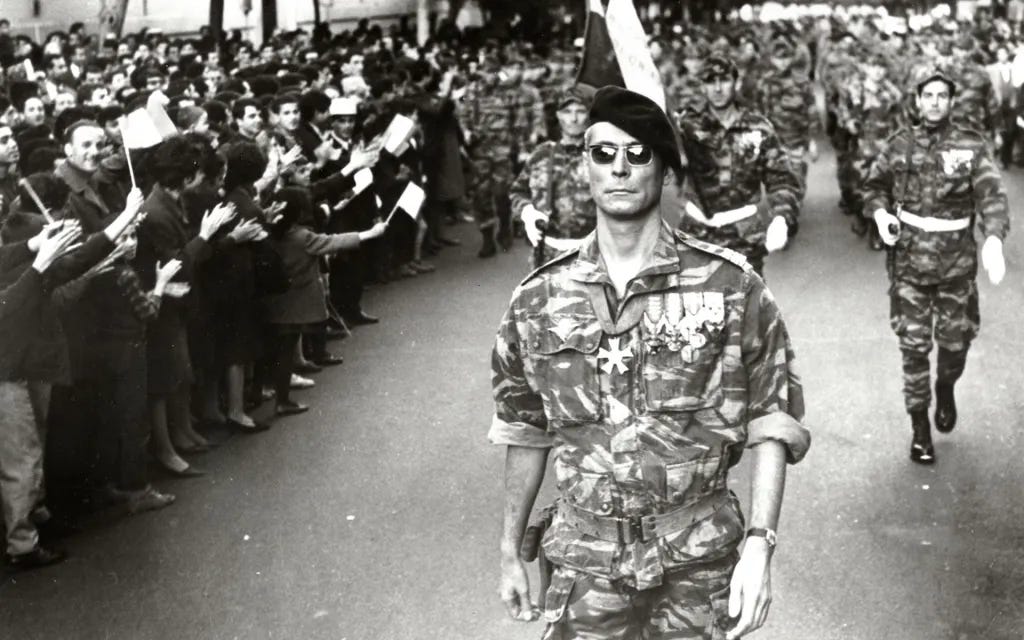
The Battle of Algiers is a semi-historical account of the French attempt to combat the Algerian nationalist insurgency, focusing on the early phase of the conflict in Algiers. The insurgents resort to indiscriminate targeting of civilians—a precursor of the later unbridled massacres of the FLN.

Likewise, the French—despite being former resistance fighters against Nazi occupation—resort to the torture and killing of Algerians in a hopeless fight against an enemy they cannot begin to understand.

Both sides are pursuing what they conceive of as their national interests—for the Algerians, it’s a free and sovereign nation, and for the French, what they perceive as an integral part of France itself. The Algerians end up finding themselves free, but trapped with an autocratic government. The French find themselves facing down a coup attempt from paratroopers who style themselves as men of action, who should steer the fate of France.

What we choose to do—and how we choose to do it—is who we are. We can attempt to separate these two things. We can say that what we do for national security is distinct from our domestic life. It is not.

Z
550x331.6620879120879

Where does national security end? Who decides what constitutes a threat to security? Does national security include our fellow citizens?

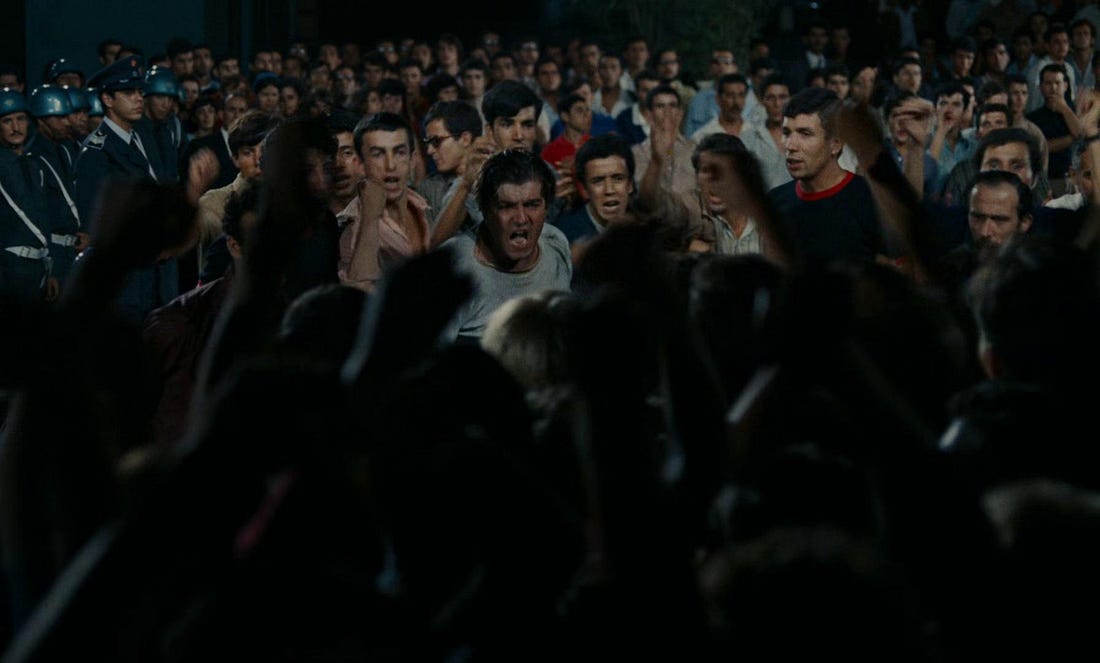
Z follows the course of an internal plot—heavily based on the establishment of the Greek Junta in 1967—to stifle a domestic democratic movement and install a military junta in the name of national security.

The members of this movement, you see, are a threat to the foundations of the State and are harming the Nation.

Is there no greater national security threat than the risk from radicals within? Isn’t anyone opposed to the interests of your political faction a threat? I mean, after all, you are the one who actually understands what the country actually needs.

How far can you blur a line? What can’t be a national security threat if you draw no bounds around the profession? Any political opposition can be labeled as a threat. Any neighbor can be an enemy in waiting.

What stops the security forces of any nation from seeing itself as the only true arbiter of what is or is not acceptable?

1

I’ll admit, this is a very Franco-American-centric list. I’m American. I was (once) fluent in French. What do you want from me?

6 Likes

Project Hail Mary

This mega successful adaptation of another Andy Weir („The Martian“) sci-fi bestseller has a great premise: an unknown particle swarm robs the energy of our sun which will have life ending consequences within the next 30 years. A suicide mission sends three astronauts into space to explore and hopefully find a solution. One of the astronauts is a scientist turned teacher who is sent against his will because he is no hero. And when he wakes up from hypersleep he is alone because the other two have died. He then makes contact with another alien whose planet also is about to die due to these particles. They join forces and find a solution.

The always charming and funny Ryan Gosling and German award magnet Sandra Hueller deliver excellent performances. And the whole enterprise is… well… nice. But its pacing is scattershot, it quickly loses the urgency of its premise and indulges in easy and hip jokes during the encounter with the alien. And then it commits the cardinal sin of threatening the death of a major character only to resurrect it, and afterwards another reversal turns into a most unbelievable deus ex machina happy ending, robbing the story its impact.

If one compares the 1972 „Silent Running“ with this film one can clearly see parallels but also the infantilization that has happened in the meantime to US mainstream cinema. This film could have been interesting but instead it turns into a feel good Marvelized mess, easy to watch but forgettable and bland. And the treatment of the alien is extremely disappointing since it turns out to be like a pet, a funny talking dog. Even the 1985 sci-fi spectacle „Enemy Mine“ allowed an alien characterization that was respectful and adult.

We‘re living in dumbed down times.

5 Likes

Passenger 57.

Stoopid-oopid but undeservedly forgotten; daft in a very engaging way. Whatever happened to Bruce Payne? He’s absolutely smashing in this.

4 Likes

Yes, that was a good movie–with Wesley Snipes AND Elizabeth Hurley! Die Hard on a plane! I also agree that Bruce Payne was great in it. I expected to see him in more things and thought he might even make a good henchman or villain in a future Bond film, but I don’t think I ever saw him in anything else. :frowning:

2 Likes

Payne slipped firmly into B-movie territory and lives in infamy thanks to Dungeons & Dragons (the original 2000 one) and Highlander: Endgame.

2 Likes

The Sheep Detectives.

A very charming family film.

2 Likes

Yesterday I watched Dip Huet Seung Hung (I had to look this up!) aka The Killer (1989) from John Woo with Chow Yun-Fat and Danny Lee now on a fantastic 4K from Arrow.

It is one of those very influential Hong Kong heroic bloodshed movies which was copied in the West a lot of times, but was never equaled.

Coming tuesday I will receive the other one, Hard Boiled, also from Woo with Chow on 4K, so I am realy looking forward to that.

5 Likes

Doctor No. Which usually isn’t something special. What made it special was the fact that it was “film on film”, restored copy (as good as possible – condition was described as “satisfactory”) from the DFF archives. This on was definitely assembled from several copies. The UA intro logo was the one from the 1980s (with the UA rotating in), “Albert R. Broccoli and Harry Saltzman present” was in French (looked “old”, maybe 1960s) and the main titles were in German - definitely old and lettered by hand, and judging from the wording this one was a copy from the early 60s. Some acts were better, some were worse. Sometimes there were visible lines and scratches for a minute or two, sometimes it was crisp and clear (and I must say that I’ve rarely seen a better gunbarrel), a few jumps and skips with one or the other second missing – basically like listening to an old vinyl record that has been played a lot in its days.

Audience was great, no silly giggling, stupid comments or Ohs and Ahs in the wrong places, like you have it oftentimes when watching old Bond movies in a cinema (last time OHMSS was absolutely horrible) – in fact it’s been a while that I had the feeling that an audience really loved the movie.

The projector was operated by two young people who had just learned how to operate a 35mm projector, and the manager made an appeal especially to the young people in the audience to visit courses on how to operate projectors before the knowledge is widely lost.

10 Likes

That’s so cool. I always hope to get to see an old Bond movie on film. I’ve seen Lawrence of Arabia on 70mm and I’m going to see Raiders in June on 35mm, but these are original prints. It’s just nice to see movies that feel like movies.

6 Likes

One of my greatest cinema experiences was watching GWTW on the big screen. My brother and I had both just finished reading David O. Selznick’s Hollywood by Ronald Haver, and we were both eager to see GWTW – which had never been shown on German TV. And out of the blue, one Sunday afternoon, there was a showing of GWTW in our hometown’s cinema. My brother came up with the idea to ask our grandma to come with us. She asked a friend to join, and so we went, two young boys, 14 and 17, and two old ladies in their seventies to see a classic Hollywood movie. Taking Granny with us was a win-win situation because we made big points with her and we didn’t have to pay for the tickets :smirking_face:
Great memories, and in hindsight, I like the fact that my first showing of GWTW was on the big screen (where it belongs). The German TV premiere was a few months after that. :nerd_face:

What was a revelation on the big screen was Once Upon a Time in the West. I always liked the movie, but in the back of my mind, I always had the thought “Yes, it’s a great movie, but what is all the fuzz about?” Go see it on the big screen and you’ll know … :smirking_face:

Lawrence is still on my list. Hoping to catch one with oerture and intermission. And then there’s the one I’ll probably never achieve – if a screening happens at all, chances are high that I’d have to learn about it early enough in order to be able to plan a holiday week around it. Screenings of How the West Was Won on an adequate screen happen once, maybe twice within two years around the world, usually far away from my neck of the woods…

8 Likes

Yes, ours had the overture and intermission. Experiencing that in an old theater is the closest thing to a Time Machine that exists. When the words “and introducing Peter O’Toole as T.E. Lawrence” appeared on screen during the opening credits the room burst into a round of applause. I’ll never forget it.

5 Likes

They just did it at The Paris Theatre (now owned by Netflix).

Also, every year MOMI does a See It Big: 70mm! Festival in Queens, and LOA is in heavy rotation among the films they show. 2001 is shown every year.

See It Big: 70mm!
July 31–August 30
MoMI’s annual summer tradition returns with a thrilling selection of films screening in 70mm prints. With a larger frame size that captures more detail and light, 70mm offers the biggest, brightest image—the ideal film format for ambitious cinematic spectacle. The centerpiece remains 2001: A Space Odyssey, and there’s nowhere better in New York to watch Stanley Kubrick’s monolithic masterpiece than in the Sumner M. Redstone Theater, which was designed with an eye towards its space-age aesthetic. More exciting titles to be announced! Presented by MUBI

If you make it over, your ticket and popcorn are on me.

5 Likes

Lat Sau San Taam aka Hard-Boiled (HK 1992) van John Woo.

After The Killer I also bought this one on 4K from the Arrow label.

It’s looks great and for the first time I liked the movie from beginning to end.

The opening scene sets the tone and bullets are flying around you within five minutes.

But that is nothing compared to the final with consists of one big long shootout inside a hospital for no less than half an hour.

And how do we top that? Well, we just blow up the whole hospital! Hahaha!

This is Woo at his best! He even has a small part himself as an ex-cop who gives the main character, played by the charismatic and inevitable Chow Yun-fat, with words and assistence.

Great movie!

5 Likes

Watched Where the Crawdads Sing tonight. I thought the movie was pretty good but was surprised to learn that it was pretty much panned by critics after pulling up some reviews afterward. I would agree with a good bit of the criticism that I read, with the backstory that plays out in between the courtroom segments to be the more compelling aspect, but both those segments as well as the courtroom drama at the center of it do come off a bit tepid at the end of the day. The acting from the leads playing love interests to the main character, Kya, is fairly one note and it’s abundantly clear through the performances, even before movie reveals one of their true intentions, who it is that you’re supposed to be rooting for.

What makes the film work is Daisy Edgar-Jones. I thought she was fantastic in Twisters, a film that is not exactly set up to showcase the acting chops of its cast, so I wanted to check out more of her work. She’s phenomenal in this film and, now having seen two of her films, I’m left rather confused as to why she’s not an A-list superstar at this point. A really, really good performance here that quite literally carries the movie.

3 Likes

Red Eagle starring Timothy Dalton. The whole thing is up on YouTube, so I thought it was worth a look.

Despite the presence of Dalton, this is definitely aiming for a more serious spy thriller than Bond. The first half takes place against the backdrop of riots in Luxembourg and the second in the Nagorno-Karabakh region. There’s nothing glamorous about the locations or what’s happening. It’s much more about the dirty side of espionage, and the film has some quite brutal scenes of what happens to innocent people in this conflict.

Oddly, there is a plot concerning oil pipelines which reminded me of The World Is Not Enough, released 5 years later.

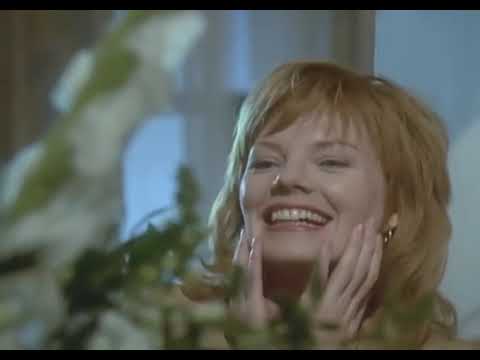
Considering this is a TV movie, there’s an interesting cast. Along with Dalton, you have Nigel Havers, Marg Helgenberger (CSI), Jürgen Prochnow and Paul Freeman. There are appearances from Bond alumni Kabir Bedi and Nadim Sawalha.

But the strangest detail is that the opening credits clearly state ‘Omar Sharif as Safar Kahn.’ Throughout the film, characters talk about Safar Khan a lot as he’s pivotal to the plot. But when Sharif appears, they conceal his character’s identity and treat the revelation as a surprise. This is the only instance I can think of where a film spoils a surprise in the opening credits!

Is it any good? Not really. It can be quite dull, and at 3 hours, it feels overly long. I watched it in two sittings (I believe it originally aired in two parts), only coming back as I thought it would liven up in the war zone. It’s also not helped that, despite the talents of the three main actors, the leads aren’t particularly compelling or likeable. And I can’t tell if Dalton’s American accent is bad, or just sounds wrong coming from him. The supporting cast is a little better, with Bedi and Sharif being the standouts.

But honestly, this just makes me want to watch Licence to Kill.

6 Likes

Fresh (2022)
Sebastian Stan, Daisy Edgar-Jones
Dir. Mimi Cave

Went into this one completely blind, as I continued this weekend with my dive into Daisy Edgar-Jones’ filmography, which made it for a much wilder ride than it would have been if you had an idea of what it was about going in. I knew it was a horror film, which left me rather confused by the first 33 minutes of the film, all of which serve as a pre-title sequence. The title sequence literally begins at the 33-minute mark of the film and brings with it the shift in the film that takes the film from being basically every modern romantic comedy you’ve ever seen into the horror film that you thought you had signed up for when you hit “play”.

The film opens with Noa (Daisy Edgar-Jones) going on a date with a real loser that she meets on a dating app. This is to set the stage both for the state of dating in the 2020s but also to show how Noa’s luck has been going in her quest to find a match, thus making the chance encounter with Steve (Sebastian Stan), a doctor no less,in the supermarket feel like a real breath of fresh air. From there, it’s every rom com you’ve ever seen. The two quickly take to each other and eventually plan for a romantic getaway over an upcoming weekend.

Then the title sequence hits.

What Fresh ultimately ends up being is the natural conclusion to the question "What would it look like if a 30-something Hannibal Lecter were somehow dropped into modern day and had to navigate the pitfalls of dating in the 2020s. There are clear influences to be found here for sure, such as Hannibal, Get Out Ex Machina, and every rom com you’ve seen in the past 10-20 years. It’s all here in this strange and often off-putting film that is never scary as such, but rather just makes you feel uncomfortable for much of its duration.

Sebastian Stan is very much the star of this film, turning in a performance that is, in moments, somewhat reserved and then, in others, completely off the wall. It meshes well with Daisy Edgar-Jones more understated approach, as she is the audience’s pathway into this bizarre situation, while also giving Stan the room in which he needs to pull off his character while also deftly navigating the swings in temperament and motivation that face her character as events unfold.

At the end of the day, Fresh is an odd film and one that I did enjoy, mainly due to the performances of the leads, but doubt I’ll need or want to watch again. It leans heavily into the gruesomeness of Hannibal, both in terms of the visuals that film presented as well as the subject matter at hand, and, at times, the oddity of Ex Machina, with one of the odder parts of the scenes leading up to the event that sends the film towards its climax feeling as though it was directly inspired by the odd dancing scene in Ex Machina. Fresh is at its strongest when it’s focusing on the interplay between Stan and Edgar-Jones, allowing that to build the tension and the horror of the film and at its weakest when it’s leaning into the gruesome nature that the subject matter invites into the film.

5 Likes

Licence to Kill. Bond really is at his best in the tropics.

7 Likes

Watched Scott Derrickson’s The Black Phone, which is based on the short story by Joe Hill, aka Stephen King’s son. Ethan Hawke is really creepy as The Grabber, although a good amount of credit there has to go to the team behind the mask, which changes based on the emotions of The Grabber and is clearly somewhat modular as we see it in different states throughout the film.

The story is a basic kidnapping thriller where we follow the ordeals of a boy who is taken by Hawke’s character and kept in a basement with only a cot and a black rotary telephone attached to the wall that supposedly doesn’t work. We find out that it does work, however, as the boy can communicate through it with the souls of the children that The Grabber has already killed before the events of this film. There’s also a supernatural element to the film that involves the boy’s sister, which, while interesting, does allow for the film to come to a much quicker and easier resolution than you would want from a thriller like this.

The strength of the film is in its visuals. It feels like one of those kind of films, at least visually, that could have come straight out of the 1970s. When it’s dealing primarily with the real world that the film takes place in, the film is at its strongest. The supernatural elements could have been more interesting, but they’re simply presented in a way that they’re mainly on display to move the plot forward and not fleshed out enough to make you think that they exist for anything other than to resolve the events of the film in a certain amount of time.

Will be checking out The Black Phone 2 at some point soon, which I thought looked pretty good from the trailers, which was the main reason that I decided to give his one a watch in the first place.

4 Likes