The Saint Thread (Again)

Well, I’m just throwing the idea out there; I have no real stake in whether they go for it or not (and there’s not much chance they would). But speaking only for myself, I’d applaud a “massively scaled down budget” for the films.

I don’t know, it just occurs to me that for many viewers – definitely including myself – the chief appeal is the character and NOT the lead actor. Which is not to say they haven’t all contributed something, but as a huge Roger Moore fan who’s nonetheless plunked down cash to see every film starrring his 3 successors – two of whom couldn’t be any less like Roger – Bond’s appeal to me obviously transcends the lead actor. And for those fans who’ve been with it even longer than I have, that’s even more the case. I get where it’s easier to “sell” a face you already spent millions promoting two years ago, and two years before that, but honestly I seriously doubt there are very many people out there thinking, “I’m only going if Craig’s in it.” Honestly at this point they could go back to the OHMSS campaign with a silhouette or question mark in place of a face and still sell tickets. And if it spared us another boring photo-poster, I’d be all for it.

4 Likes

Got it. Random thoughts, and I bow to the greater industry knowledge in the community. Just my mental doodling.

But will those machines be called upon as they have in the past in an Amazon Prime/streaming universe? I know that the good word of the moment is a continued commitment to the theatrical release of Bond movies, but did Amazon pay all that money only to be tied to a release strategy not of its own design? Especially, in an environment whose contours are not yet fully evident?

If in its first weekend BLACK WDOW makes $80 million theatrical and $60 million streaming, and then has a 67% decline the next weekend in theatrical, how strong are the legs of the theatrical release model? I do not believe that the studios are going to rise up as one and say: “We are leaving money on the table doing simultaneous theatrical/streaming openings. Let’s dump streaming.” They will adjust budgets to be in line with the new revenue totals being generated.

If Universal paid $400 million for an Exorcist Trilogy, doesn’t that indicate that contracts will be different in the future, with artists’ money paid upfront, and not tied to a movie’s theatrical box office? As Deep Throat reminds us: follow the money.

In a world of influencers, how much power does product placement retain? Where is the bigger bang for the buck? Do more people want to have a James Bond moment, or a Tyler or Marina in their bedroom moment?

Admittedly, I am an old goat. I love seeing movies in theaters, and either out of stupidity or faith, just bought two passes to the New York Film Festival, which I first attended when I was 17 years old (this will be my 45th NYFF). I talk to my husband and younger friends, and they regard my love of watching movies in theaters with the indulgent fondness people have for Grandpa and his stories about trekking through six-foot high snow drifts to get to school. Heck: my husband watches something on his phone and on the television at the same time! When I put in my new Blu-ray of Luis Bunuel’s BELLE DE JOUR (report coming soon), I turned off all the lights in the apartment and shut off my phone.

For all the impassioned treatises from Denis Villeneuve and Christopher Nolan, they still need the companies (I can’t really say studios any more) to provide the money for their extravagant films. Martin Scorsese’s next movie will be released theatrically by Paramount, but is being financed by Apple TV+. His last, THE IRISHMAN, played in fewer than five theaters in New York City. Five. NYC. Scorsese.

THUDERBALL: $9 million budget
YOU ONLY LIVE TWICE: $9.5 million budget
DIAMONDS ARE FOREVER: $7.2 million budget

Twenty-five percent budget reduction resulted in a hundred-fold increase in aesthetic value.

Moral: less is sometimes much, much more.

2 Likes

Absolutely.

You mean…

6 Likes

Touche. LOL

Part of the problem with the Ryan films is that we all know no one intended them to be one-offs, so the constant recasting sends the message “we just can’t get this right.” Maybe if you said up front you were going to switch it up, it’d be different.

Consider all the time we spend on here wondering what if Richard Johnson or Laurence Harvey or Lewis Collins or Sam Neill or Michael Fassbender or whomever had gotten a shot before they aged out. What if they could? Even if just once? Think how much easier it’d be for Eon to weather a firestorm from certain quarters if an actor of color got a “turn” that didn’t have to stretch into an “era”. Or if someone came up with a great “Old Man Bond” or “Death of Bond” or “Bond in the 1950s” story that could be told without having to change the whole course of the series, long term?

I’m not sure why I’m spending so much time on what’s really just a silly whim that only hit me this morning. Maybe it’s just that I’m at the age where I know there’s more “Bond variety” in my past than is left in my limited future. Or because we’re at the tail end of a 5 -film arc that, unless NTTD changes my mind, didn’t add much of interest after the first entry. Anyway, it’s a thought to pass some time.

3 Likes

Exactly. Such a firestorm is something Amazon wants to avoid at all costs. It needs Bond films to be popular and make money, and having yet another white actor play a legacy role for another era could damage a franchise that survived a Tarzan yell, an invisible car, and much else. Had Craig exited sooner, they probably could have squeezed in one more white guy, but the world changed faster. If they pick a white actor for Bond 7, the questions will be: “Were there no black/brown actors who were available/qualified?” “Who was on the shortlist?”

Maybe what appears as a silly whim, actually contains a powerful dose of insight into the world at this moment (at least I thought so when I read your first post).

3 Likes

I’m wondering a bit about this.

If we look at Craig’s case, what did actually happen?

A left field actor got the role, somebody with neither the typical Bond look (up to then) nor the big fanbase. While a significant part of the previous actor’s fanbase was still miffed about their man’s loss. So far so predictable.

Then came that obscure little Craig-not crowd and spilled their guts to a frenzied tabloid pack that couldn’t believe their luck: gratuitous headlines running from too blond, too short nonsense to outright lies like can’t drive stick - complaints by people who have trouble wrapping their heads around the concept of ‘acting’ as opposed to ‘being’ and mistake Fleming’s books for a holy scripture from a prophet.

A question of personal like or dislike briefly became a quasi-religious storm in a media cup. And for what? The tabloids sucked up at the first chance to get on Eon’s good side and cheer with the winners. While the whole idiocy, if anything, just achieved to interest people who wouldn’t otherwise have cared.

Casting the next Bond will be controversial no matter who is going to be the lucky one. Craig’s case has shown that controversy need not be a bad thing - and could well be turned into an asset.

Always provided the actor chosen succeeds in the role and wins over sceptics.

5 Likes

The idea of changing actors per film has been intriguing for me as well, just like the idea of “auteur”-directors making one film each with their personal vision of Bond.

However, both ideas don’t work for a longtime strategy. It would signal “okay, we’re through with ideas, we now try to squeeze out some new flavors by applying different cooks”.

What always has worked best was getting an actor who would become the “ambassador for Bond”, someone who would supply consistency and a certain image which could interest the current generation until he had to be replaced. Moore was probably the most successful one in that regard since he clearly enjoyed being Bond outside of the films as well. Brosnan would have carried that torch for a longer time as well.

After Craig, I think, it will need someone to carry Bond into the next generation. And it needs to be one who is nothing like his predecessors but someone who adds something unexpected and fresh.

Returning to this thread´s topic, I guess the choice is perfect because he really adds that what is needed.

3 Likes

Agreed. But the clamor for a non-white Bond was low, if not below the threshold of most people’s hearing. A white male was going to succeed six prior white males–that fundamental fact was not in doubt.

So whether the named Bond was obscure and blond or known and brunette was window dressing on the major fact that he would be white.

1 Like

You make a huge point, here.

With Bond, the whole has always been greater than the sum of the parts, and that’s true for the series overall as well as the individual actor “eras.” There are folks who are 100% dead certain Connery will always be the best Bond, for instance, but may or may not be able to name any of his Bond films. It’s the total image that matters, not any particular performance.

I’ve known folks who, when asked to name their favorite Connery Bond film, describe an imagined opus that includes the Aston Martin, a jetpack and a volcano lair. Or people who say they love Roger’s Bond, especially the one with the alligators and the underwater car. At some point everything blurs together to create a sort of amalgam of all the “best bits” from each era, and that’s what people envision when those actors’ names come up.

In that sense, it doesn’t matter if Spectre stinks; Craig is still “great” based on the strength of his other films, and NTTD will doubtless “make up for it.” So from that perspective – not having to prove yourself every time and being able to coast a bit on accumulated goodwill – it makes total sense to keep the same face in the tux for extended runs.

3 Likes

There’s also the fact that, contrary to what we think and what we claim, we actually like the well-known: seeing familiar faces doing familiar things in familiar ways.

Whether that’s Midsomer Murders or Friends, Ethan Hunt or James Bond, Doctor Who or The Simpsons: the appeal is not so much the gradual variation in these series but the constant element of their protagonists* and the respective recipe they follow.

Of course people want more than just reruns and remakes - but not so much different from what came before, that’s the appeal of the serial character. Some things don’t change (a lot).

*Especially with Doctor Who who remains, in all incarnations, a Time Lord.

1 Like

I love this. Riffing on it: I never enjoyed Timothy Dalton as Ambassador for Bond (or he was least effective in this role).

I think he is the first one to be the Ambassador for Bond–a role that all post-Connery Bonds must play (and then be measured against how Moore handled the responsibility).

1 Like

Well, I don’t think he enjoyed it much, at least the “press tour” end of it.

Or maybe you mean some guys have been better about “representing” even without trying hard. Certainly with Roger, Sean and Pierce, there was always an impression among the general public of “That guy is so James Bond” even when they were doing something else entirely (and maybe didn’t WANT to be confused with Bond), whereas with Dalton one had the impression it took real acting talent and effort to get into character.

1 Like

…and they called it GoldenEye

1 Like

image

2 Likes

Ron. Swanson.

Still the spin-off I’m waiting for.

1 Like

For viewers in the UK , the talking pictures TV channel are going to be showing black and white Roger Moore episodes from tomorrow evening and every Sunday at 6pm

ITV4 only shows the colour episodes

3 Likes

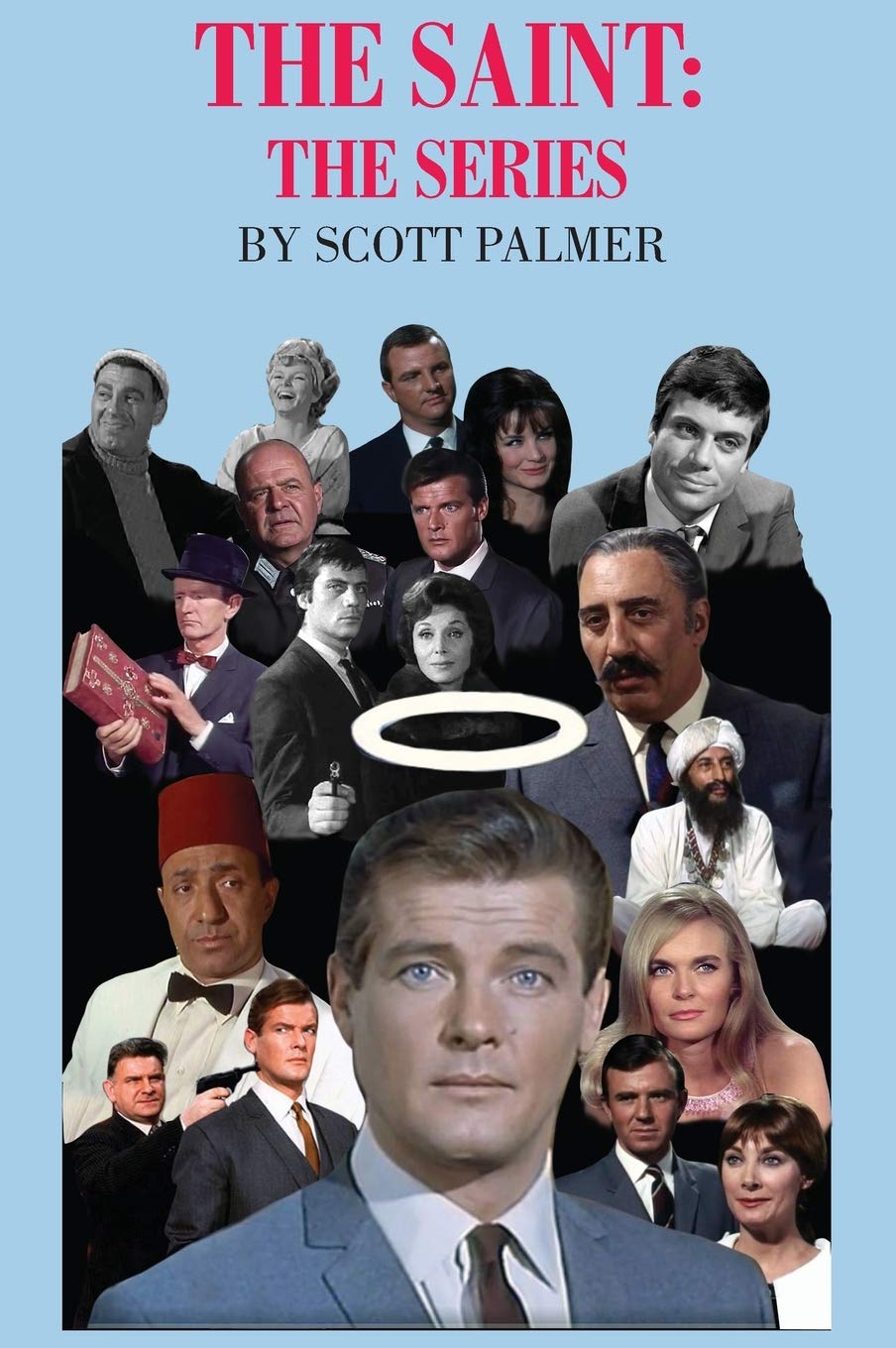
By the way there’s a new book released about the Roger Moore Saint series:

There’s also a book about The Persuaders by the same author.

4 Likes

Kindly give us an isbn number so I can easily find this book and see if the book is a decent addition to my collection.

It’s on Amazon.co.uk
Just type in the title and you will see it.