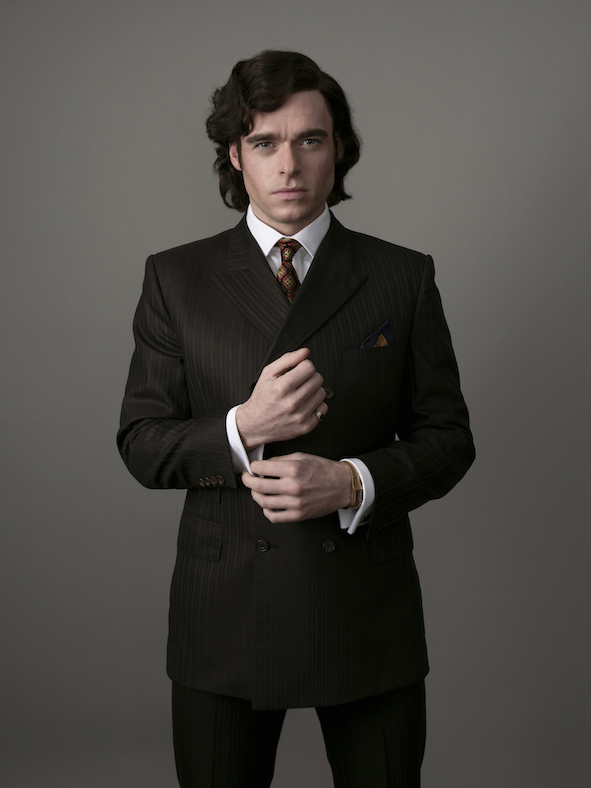
But it’s testament to his acting skills that he can Be equally convincing as wimp and hardcase. Useful skill for a secret agent.
If you haven’t seen it watch the excellent thriller The Guest. He wasn’t on my bond radar at all, but that role completely sold me on him as Bond. Also happens to be a great movie.
When the new Bond is needed, I wonder if they will want the character to have a sense of “dangerous unpredictability,” and how such a quality will be understood at that date.
I say this having recently watched a favorite Mankiewicz film “GUYS AND DOLLS.” There is a moment early on when Sky grabs Sister Sarah and kisses her. The passion (thanks to Brando) is unmissable, but I can see how it plays differently now–no longer “just what men do when they are near a women they want,” but an unwanted advance into personal space. What is interesting is how Brando’s passion, Simmons’ response, and Mankiewicz’s mise en scene allow this scene (to my eyes) still to work.
Later in the Havana sequence, Sarah asks for a milkshake and Sky orders Dulce de Leche’s. Sarah loves the drink, and when she asks Sky about the Bacardi in it, he says it is a preservative for the hot weather. He also silently motions to the waiter to bring more. Sky later tries to sober Sarah up by urging coffee on her (the entire Havana sequence is saved by the abilities of three very talented artists), but the scene is not quite as smooth/comedic as I remember it from my earlier encounters of it on stage and screen. Similar issues came up in recent revivals of “My Fair Lady” (brilliantly solved); “Carousel” (glided over/avoided); and “Kiss Me Kate” (still problematic).
I would be happy with a Gentleman Bond for the 21st century–possibly an update of Moore Bond circa MOONRAKER. Dangerous unpredictability is too close to gay (and other forms of) bashing for me. The “you never know what he is going to do–he’s a man after all” approach is not appealing.
Lastly, if odd_jobbies (and/or others) wouldn’t mind: what is the appeal of “dangerous unpredictability” in a character? I know you are not enjoying it as a potential to bash, but while spontaneity is fun, dangerous unpredictability seems like something to be avoided. Would a parent cultivate such an attitude in their child? Might its enjoyment entail the vicarious pleasure of an attitude that is verboten in life, thus becoming attractive on screen?
Some very salient points there, I wonder if I am taking dangerous unpredictability to mean something slightly different, or rather, more nuanced. More like what Cagney had or Bogart or McQueen. This fire inside them that makes them so compelling and complicated to watch. It’s different from the gravitas of Jimmy Stewart for example, or Lazenby as Bond actually.
Hiddleston for me, doesn’t have that fire nor does Stevens ( both have to have it telegraphed in performance - the pool sequence in King Kong as an example )
There is this scene in CASINO ROYALE when Bond is cleaned out, furious like a beaten schoolboy. He glimpses Le Chiffre - after downing his signature drink which he orders like a human being, not like a picky cardboard caricature of himself - grabs a nearby steak knife and sets out to finish him. This scene is not in the book (and ultimately, it condenses all of LICENCE TO KILL into a mere seven or eight seconds), yet it’s indeed closer to Fleming than one might think. Just look at Bond throwing himself hopelessly at Goldfinger in the novel or downing the plane with his hidden dagger.
It’s not a quality as such, nothing you would cultivate in a child or even yourself. It’s a fallback to a way of instinctive acting from times when humans moved and hunted in jungles and caves, without much planning beforehand.
Bond is not 100 per cent the nice guy, just as his job isn’t 100 per cent the glorious adventure the usual suspects make it out to be when they recruit you or fool the public in a hearing. But this streak of the - predatory? murderous? - basically untameable nature is something Bond has to have when it comes to survive that stairway fight. It’s this what makes people merely dream about Bond, being him, being with him, instead of pursuing such a life for real. It’s that grain of truth in the tale of the fantasy spy, that walking around and killing people, even if they are ‘bad people’, just isn’t something one can do as a sane character without consequence.
But isn’t that exactly what Fleming was doing when creating Bond: living out a fantasy he knew he could never have as he prepared for marriage. Of course, Bond needs to keep moving with the times to avoid becoming pastiche or just plain offensive, but he should always sit on the edge of what is appropriate, whether his next incarnation is closer to Moore’s gentleman Bond or Craig’s brutal assassin. As long as Bond retains traits of being Bond, I am equally open to any variation on that spectrum.
I agree with you on a lot of points you made here - but maybe the term “dangerous unpredictability” is misleading.
As Dustin said, Bond is not a nice guy. And he needs to be able to become dangerously unpredictable when he fights for his life.
But Fleming stressed the idea that Bond hates killing. He is not an unhinged psychopath.
Unfortunately, the “dangerous unpredictability” seems to have been turned into an attraction during the last two decades in pop culture. Anti-heroes with those traits became cool and attractive, and heroes who acted according to moral codes and rules were considered boring. The best example for that is the popularity rising for Batman and against Superman.
And that’s what also marked the change in perception from the previous Bonds to CraigBond. One could believe and see that CraigBond would give in to hate and aggression at any moment, in sharp contrast to previous Bonds. And that probably was the right choice to keep Bond popular in those times.
But the next Bond, I hope, will have more of a moral center again, someone who can be cruel when he needs to be but not because he cannot control himself due to personal rage.
I would agree with that asessment, overall. I felt the Connery model Bond had no problem killing when the job called for it, and Moore’s Bond seemed to kill out of a sense of patriotic duty (and usually after working up a personal disdain for the target). With Craig I always feel like if he hadn’t been hired on by MI-6, he’d just have been out killing somebody anyway, if only to pass the time.
I don’t know that he comes off as a rage monster, though. More like an emotionless Terminator type. The closest I remember him coming to rage was the furious look he gave when Silva’s men blew up the DB5 in SF (which, by the way, generated huge --presumably unintended – laughter from the audience I was with).
I have to disagree with you , I always thought that of all the 007s Connery looked most like he could have been killing to pass time, in his free time. With CraigBond and DaltonBond , I think there is a sense in the performances of how the act of killing affects them. BrosnanBond attempts to convey this but is let down by the permiating sense of nostalgia that shackled his tenure.
ConneryBond has no such affectations and is a cold cruel killer and possibly the least “Fleming” of the Bonds bit the genius of his performance was to at once convince as this whilst at the same time telling the audience that this is fantasy, sending his performance up whilst being deadly serious when called for.
Moore kills because of disdain I agree but also because the script requires him to do so, he also , I believe plays the duality of being this character but playing himself simultaneously sending up that character.
It’s not something that’s appealing in general, but something that’s appealing in a double-0. Otherwise he’d be a rather dull character.
He’s an iconoclastic 00 in that he questions himself, his job, his superiors causing him to act autonomously. This introspection makes him interesting and that’s all part and parcel of him being unpredictable; in his profession that’s a quality dangerous to others and himself; again that’s a point of fascination that makes Flemings Bond jump off the page more than most protagonists of the genre.
Having an unpredictable and dangerous secret agent is only a threat to women or the sexuality of the LGBT community if one wants it to be. I certainly don’t see that as part and parcel of unpredictable danger any more than I believe BB or Craig does. It would play fine at anytime imo. Without ‘dangerous unpredictability’ the only way to keep it entertaining is to make it comedy as with Moore.
And having said all that I think gender equality and the LGBT community should be lampooned with equal relish as every other aspect of our culture whenever context calls for it. The scripts themselves should be dangerous and unpredictable.
Because what’s “funny” is Craig’s comically overblown reaction, which is at odds with his normally stoic demeanor, the general humorless nature of his films and the overall goal of the “seige of Skyfall” sequence.
I don’t know, maybe Mendes did decide to take a moment out of the action climax for a broad comedy bit, but from where I sat it didn’t feel like it. In fact it’s been a while so I don’t remember, but could Bond even see what caused that “bang” from his vantage point?
The other big laugh in a Craig Bond came in SP, when M says, " …And now we know what ‘C’ stands for ". I thought the roof would come off the place from laughter. Then M adds, “…Careless,” and everyone goes, " Oh. Nevermind. "
I think that’s a fair take. Out of all of them, Connery’s the only one who you can’t imagine ever giving a second thought to any of his kills. But his Bond was always positioned as a fantasy figure, and his films always had a tongue-in-cheek self-awareness to them (it was taken to an extreme by Moore, but pioneered by Connery). Craig’s Bonds seem to be trying to be trying to portray a less fantasy-oriented, more “realistic” world, and as a result I tend to judge his Bond more by that standard: what kind of man would act as he does in “our” world? I concede if you placed Connery-Bond in anything close to the “real world” he’d be the biggest sociopath of the lot. It would almost be worth it to have him do a scene like “I think he got the point” in a film with real world rules, with Domino going, “Holy crap! You pinned him to a tree with a spear gun!! You think that’s funny?!? What the Hell is wrong with you?” It’d be like that that SNL skit where a cartoon mascot comes to life off a box of cereal ( as they always do in commercials) and instead of the family laughing and smiling and enjoying their breakfasts, they scream and flee and try to kill the thing.
Craig’s SF DB5 reaction was definitely intentionally ‘comedic’.
There’d been chit chat throughout the production that it’d all gotten a bit serious (disingenuous really, because they’d have said the opposite if QoS had gone down better with critics). So there always seemed an agenda for Mendes to start reinserting the lighter touch.
This was exacerbated by the movie being an anniversary (lost track which anniversary now that almost every bloody Bond movie is an anniversary of something), so it was always on the cards that they’d inject ‘canon trope’ moments here and there.
Add these two studio (insert hate figure) notes together and you get a top notch thriller in its own right with incongruous Moore-era comedic tropes crowbarred into proceedings and to hell with the tone and pacing of the narrative they sabotage.
In a movie that has an old couple doing a Carry On Bond reaction to him leaping on a tube train (SFs double taking pigeon/emptying wine bottle as lotus exits ocean homage) and its impossible to see Craig’s DB5 overreaction as anything but intended ‘lol’ comedy skit.
Personally, I thought both moments where pretty $h*t
Thanks for the responses. I am on the same page with SAF when he writes:
The anti-hero introduced in the 1960’s has morphed (metastasized?) into amoral figures with whom a viewer is supposed to identify/sympathize with (I am also including television/streaming). Films always explored dark themes/situations, but it seems now that darkness itself is the value/virtue to be presented/consumed/aestheticized.
That may be why CraigBond has less appeal for me–I prefer a protagonist who is smart/clever/capable enough to avoid falling back into/onto instinctual ways of being (or it may be that I have had enough such behavior directed at me that it does not seem appealing). I have the same hope as SAF:
Exactly.
And MooreBond kills because MI-6 requires him to.
Unpredictable danger aimed at women and LGBT folk is not part of Bond–his unpredictable dangerousness is pointed in other directions. Real life has examples contrary: the gay panic defense is part and parcel of unpredictable danger: if a straight man attacks a gay man, it is because he was afraid the gay man was going to hit on him, thus providing a legitimate reason to release the kraken–I mean unpredictable danger. It is the obligation of the queer person not to stir up the danger/personal rage that exists within the person, rather than the individual’s responsibility to contain/restrain such. In today’s world being true/authenticate to one’s feelings is often held in higher esteem than in having a moral code which one follows and allows to be the north star of a person’s life.
I agree, but just do not kill us (written as the 18th transwoman murdered this year was finally identified by dental records since her body had been burned beyond recognition in her car).
Given that “moral code” in the eyes of some, those actually in power in the United States, would have you and your husband go through gay conversion therapy, it’s good that society now tries to push the concept of the individual, rather than judging themselves only by rules often decided by church and state. That is who Fleming’s Bond, and to a lesser extent Connery’s Bond, is following blindly when he kills without regret or remorse for “moral” reasons. Craig’s Bond actually does feel guilt for those he’s killed, either directly or indirectly.
Does anyone else find the discussion about heroes in film being pushed to be “Dangerously unpredictable” at the same time as a criticism of Marvel for its lighter, more simplistic, approach, a bit of a contradiction? Given the Marvel movies have taken the style of so called morality tales, praising family, standing up to bullying and a move away from hubris, arn’t they, as currently the most successful series on the planet, actively pushing for that attitude that people are saying doesn’t happen anymore? Are you, perchance, judging cinema by what it was in the 80’s and 90’s, I.e, over two decades ago?
 Maybe not even on steroids!